Eigendecomposition
Chapter 6: Geometric Transformation and Eigen Decomposition — Spectral Decomp $A=V\Lambda V^{-1}$
From the book
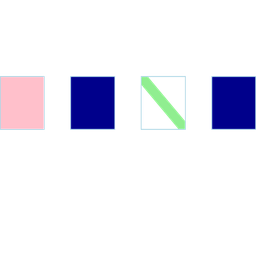
Chapter 6: Geometric Transformation and Eigen Decomposition. In the chapter mind map this icon labels Spectral Decomp $A=V\Lambda V^{-1}$. The discussion below is excerpted and lightly edited from § Spectral Decomposition in Mathematics for AI and Machine Learning.
The spectral decomposition expresses a diagonalizable matrix $A = V\Lambda V^{-1} \in \mathbb{R}^{N \times N}$ as a weighted sum of rank-1 matrices formed from its eigenvectors:
where the right eigenvectors $A\mathbf v_n = \lambda_n\mathbf v_n$ are the columns of $V$ and the left eigenvectors $\mathbf w_n^\top A = \lambda_n \mathbf w_n^\top$ (multiplying $A$ from the left) are the rows of $V^{-1}$, by row $n$ of $V^{-1}A = \Lambda V^{-1}$; $W = (V^{-1})^\top$ collects them as columns.
Each term $\lambda_n \mathbf v_n \mathbf w_n^\top$ is a rank-1 matrix that represents the contribution of the $n$-th eigenmode to the matrix $A$. The spectral decomposition reveals how $A$ acts on vectors: it projects onto each eigenvector direction, scales by the corresponding eigenvalue, and recombines the results.
Special case for symmetric matrices: When $A$ is symmetric, $\mathbf w_n = \mathbf v_n$ (left and right eigenvectors coincide), and the spectral decomposition simplifies to:
where the eigenvectors $\mathbf v_n$ form an orthonormal basis (proved in the matrix chapter). This form is particularly important in Principal Component Analysis (PCA), where symmetric covariance matrices are decomposed into principal directions.
What this drawing shows
What you see. Shows a matrix decomposed into eigenvectors and eigenvalues.
In the mind map. Chapter 6 — Spectral Decomp. See From the book above for definitions, figures, and worked examples.
Where to read next
Read the full definitions, figures, and worked examples in Chapter 6: Geometric Transformation and Eigen Decomposition — see the mind-map node Spectral Decomp.