Noise Exploration
Chapter 18: Langevin Dynamics and Sampling — Role of Noise in Sampling & Exploration
From the book
Chapter 18: Langevin Dynamics and Sampling. In the chapter mind map this icon labels Role of Noise in Sampling & Exploration. The discussion below is excerpted and lightly edited from § The Sampling vs Optimization Distinction in Mathematics for AI and Machine Learning.
This distinction between sampling and optimization is fundamental in machine learning:
- Optimization (gradient ascent/descent): Seeks to find a single point (or small set of points) that optimizes an objective function. The goal is convergence to an optimum.
- Sampling (Langevin dynamics, MCMC): Seeks to generate a sequence of points whose empirical distribution matches a target distribution. The goal is exploration and representation of the full distribution.
__In generative modeling, we need sampling, not optimization.__ We want to generate diverse samples that collectively represent the data distribution, not just find its modes.
the book figure illustrates optimization (black dashed line, stopping at the nearest mode) versus sampling (red solid line, Langevin dynamics exploring both modes) on a Gaussian mixture. The noise term turns an optimizer into a sampler with stationary distribution $p$.
This need for sampling in generative modeling directly motivates the introduction of Langevin dynamics, which provides a principled way to balance gradient guidance with exploratory noise.
What this drawing shows
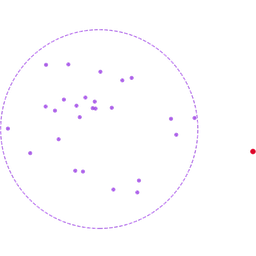
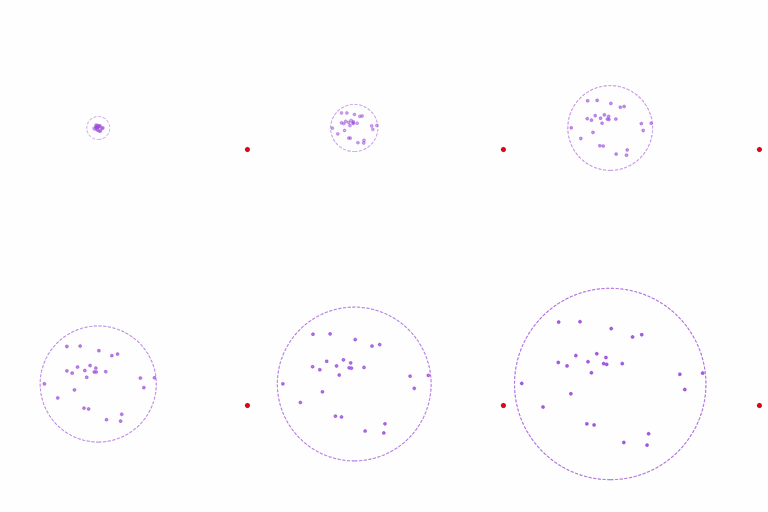
What you see. Contrasts noise-driven exploration: a purple sample cloud spreads inside the dashed region while a red mode point stays sharp.
In the mind map. Chapter 18 — Role of Noise in Sampling & Exploration. See From the book above for definitions, figures, and worked examples.
Where to read next
Read the full definitions, figures, and worked examples in Chapter 18: Langevin Dynamics and Sampling — see the mind-map node Role of Noise in Sampling & Exploration.