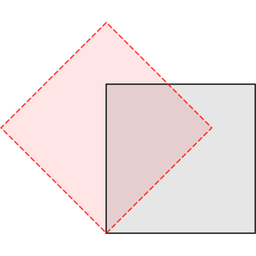
Rotation
Chapter 3: Subspaces and Orthogonality — 2D Rotation Matrices (also appears in Ch. 6)
From the book
Chapter 3: Subspaces and Orthogonality. In the chapter mind map this icon labels 2D Rotation Matrices. The discussion below is excerpted and lightly edited from § Complex Numbers and 2D Rotation Matrices in Mathematics for AI and Machine Learning. Related material also appears in Chapter 6 (Rotation).
There is a natural correspondence between complex number multiplication and 2D rotation matrices. Consider the rotation matrix that rotates a vector in $\mathbb{R}^2$ counterclockwise by angle $\theta$:
Multiplying a 2D vector $\begin{pmatrix} x \\ y \end{pmatrix}$ by $R(\theta)$ is equivalent to treating $(x, y)$ as the complex number $z = x + iy$ and multiplying by $e^{i\theta}$:
which corresponds to $(x + iy) \cdot e^{i\theta} = (x + iy)(\cos\theta + i\sin\theta) = (x\cos\theta - y\sin\theta) + i(x\sin\theta + y\cos\theta)$.
This correspondence extends to eigenvalues: the rotation matrix $R(\theta)$ has eigenvalues $e^{i\theta}$ and $e^{-i\theta}$, both with modulus 1, reflecting the fact that rotations preserve distances. Rotation returns in the matrix chapter (Section the referenced section) as one of the basic geometric transformations, alongside scaling, reflection, shear and projection.
What this drawing shows
What you see. Shows a fixed black reference square and a red dashed copy rotating slowly about the bottom-left corner from 0° to 45°, matching the chapter rotation figure.
In the mind map. Chapter 3 — 2D Rotation Matrices. See From the book above for definitions, figures, and worked examples.
Also appears in Ch. 6 (Rotation).
Where to read next
Read the full definitions, figures, and worked examples in Chapter 3: Subspaces and Orthogonality — see the mind-map node 2D Rotation Matrices.
This concept is also referenced in Chapter 6 (Rotation).